


📈 Bitcoin Climbs on Cooling Inflation
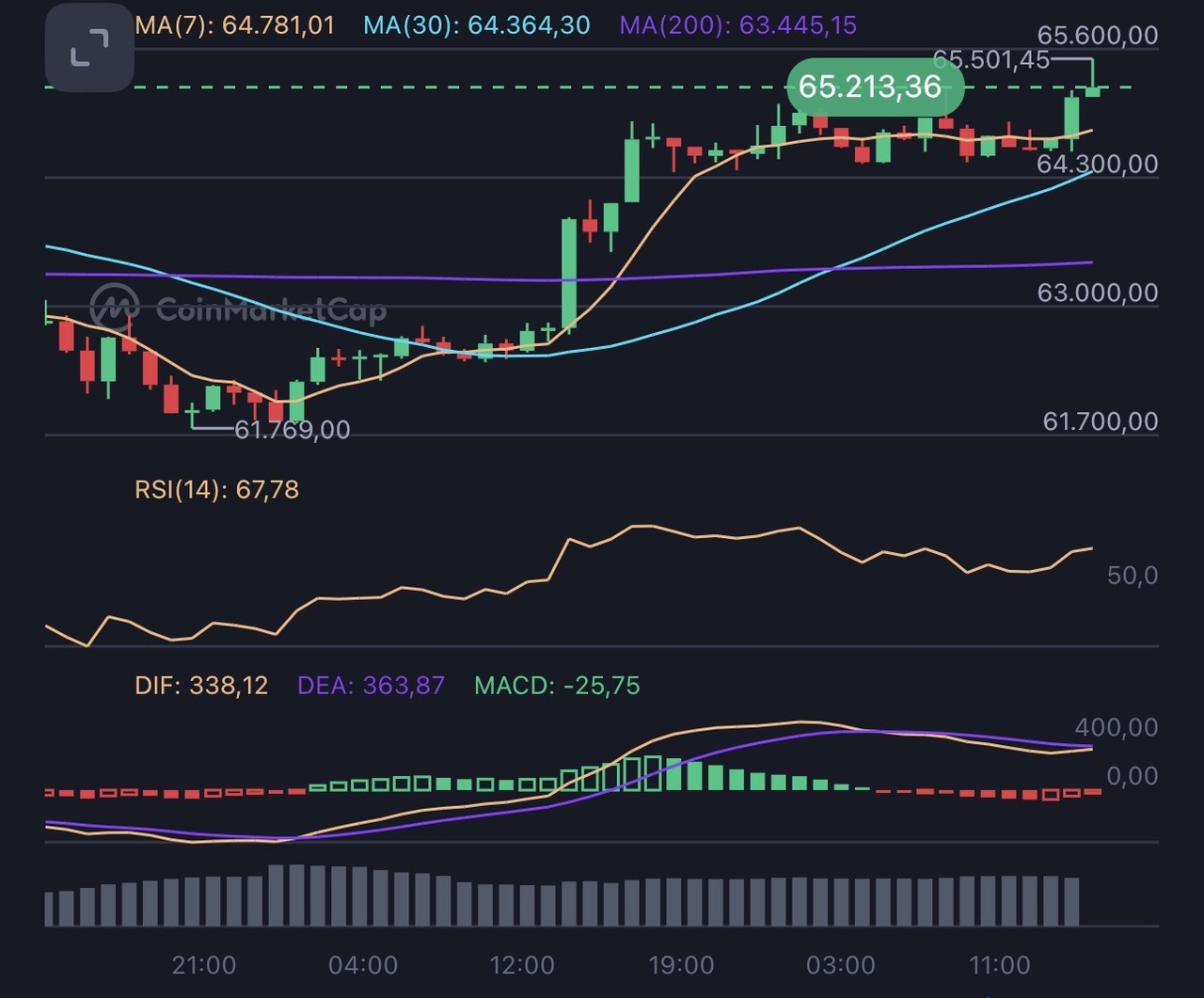
Bitcoin is up 2.38% to $65.3K, fueled by softer U.S. inflation and strong ETF inflows. Holding $63.6K could pave the way to $68K.
#Bitcoin
Bitcoin: Financial Freedom

Few technologies divide opinion as much as Bitcoin. To its supporters, it represents a once-in-a-generation breakthrough: a decentralized form of money with a fixed supply of 21 million coins, immune to political manipulation and inflation. To its critics, it’s little more than a speculative asset whose value depends entirely on finding someone willing to pay a higher price.
The real controversy, however, starts with a deeper question: Does money actually need intrinsic value? Gold is valued far beyond its industrial use, while modern fiat currencies aren’t backed by physical assets at all—they derive their value from trust in governments and central banks. Bitcoin advocates argue that Bitcoin is no different: its value comes from scarcity, security, and the trust people place in a decentralized network.
Critics counter that Bitcoin remains too volatile to function as everyday money and that most people still treat it as an investment rather than a currency. Supporters respond that nearly every transformative technology began as a niche asset before achieving mainstream adoption.
Whether Bitcoin ultimately becomes the foundation of a new financial system or is remembered as history’s greatest financial experiment remains uncertain. What is certain is this: Bitcoin has forced the world to rethink what money is—and who should control it.
Is The Lightning Network Actually „Helplessly Broken“?
Let’s Break This Down

Okay so a few weeks ago Udi Wertheimer dropped a post that basically set crypto Twitter on fire: the Lightning Network, he said, is „helplessly broken“ once quantum computers show up — and there’s literally nothing devs can do about it. Bold claim. It went viral fast. And if you’re a company running real payment rails on Lightning (or thinking about it), that headline is the kind of thing that makes you spill your coffee.
So let’s actually unpack this properly, because the truth is way more nuanced than the doom-headline suggests.
Give Credit Where It’s Due
Wertheimer isn’t some random hype account — he’s a legit, respected Bitcoin dev, and the underlying worry he’s raising is real. Quantum computers, if they ever get powerful enough, genuinely threaten the cryptography that Bitcoin and Lightning run on. Nobody’s disputing that part. And yeah, the Bitcoin dev community is already deep into working on it. But slapping „helplessly broken“ on Lightning? That’s more clickbait than clarity, and it glosses over a lot of stuff companies making real infrastructure decisions actually need to know.
What He Got Right
Here’s the deal: opening a Lightning channel means both sides have to swap public keys — that’s just how the plumbing works. In a hypothetical world where cryptographically relevant quantum computers (CRQCs) exist, someone who gets their hands on those public keys could theoretically run Shor’s algorithm, back out the private key, and yoink the funds.
That’s a real structural quirk of Lightning. No argument there.
What the Scary Headline Left Out
Here’s where it gets interesting — the actual threat is way narrower and way more conditional than „your Lightning balance can just get vacuumed up.“
First: while a channel is open, it’s basically wrapped in a hash-shaped force field. Funding transactions use P2WSH (Pay-to-Witness-Script-Hash), meaning the raw public keys inside that 2-of-2 multisig stay hidden on-chain the entire time the channel’s open. Payments themselves ride on HTLCs (Hashed Time-Lock Contracts), which lean on revealing hash preimages, not exposing keys. So a quantum attacker just chilling and watching the blockchain literally cannot see the keys they’d need. Nothing to grab.
The real danger zone shows up only during a forced settlement. The second a channel closes and a commitment transaction hits the chain, the locking scheme finally goes public — including the `local_delayedpubkey`, a standard elliptic curve public key. But here’s the catch: the node that just broadcast this can’t touch the funds right away. There’s a built-in cooldown — a CSV (CheckSequenceVerify) timelock, usually around 144 blocks, roughly 24 hours.
So in a post-quantum world, picture an attacker camping in the mempool, spotting a commitment transaction confirming, yanking that now-visible public key, firing up Shor’s algorithm to derive the private key, and racing to snatch the output before the timelock runs out. And for HTLC outputs specifically during a forced closure, that window gets even tighter — as short as 40 blocks, roughly six to seven hours.
Is this a real, specific vulnerability? Yes, 100%. But it’s a time-boxed race against an attacker who has to actively crack one of the hardest math problems humanity has ever thrown at a computer — separately, for every single output, inside a ticking clock. It’s not some silent, passive „every Lightning wallet on earth drains simultaneously“ nightmare scenario.
Meanwhile, in Reality: Quantum Hardware Isn’t There Yet
Here’s the part that never makes it into the scary headlines: quantum computers capable of actually cracking crypto don’t exist right now, full stop. And the gap between today’s hardware and what’s actually needed is genuinely massive.
Cracking Bitcoin’s elliptic curve cryptography means solving the discrete logarithm problem for a 256-bit key — that’s a number with roughly 78 digits — using millions of stable, error-corrected logical qubits running for a sustained stretch of time. For context: the biggest number ever factored using an actual Shor’s algorithm run on real quantum hardware is 21 (yep, 3 × 7), achieved back in 2012, and even that leaned on classical post-processing help. The current record-holder is a hybrid quantum-classical approach that factored a 90-bit RSA number — a genuinely cool milestone, but still roughly 2⁸³ times smaller than what you’d need to actually threaten Bitcoin.
Google’s quantum research is legit and worth keeping tabs on. Serious researchers throw around timelines ranging from optimistic (late 2020s) to way more cautious (2030s and beyond). None of that adds up to „your Lightning sats are at risk today.“
The Devs Are NOT Sitting Around
Wertheimer’s „helpless“ framing also just doesn’t match what’s actually happening on the ground. Since December alone, the Bitcoin dev community has rolled out more than five serious post-quantum proposals: SHRINCS (324-byte stateful, hash-based signatures), SHRIMPS (2.5 KB signatures built for multi-device setups, about 3x smaller than the NIST standard), BIP-360, a Blockstream paper on hash-based signatures, plus proposals for OP_SPHINCS, OP_XMSS, and STARK-based opcodes in Tapscript.
Calling Lightning „broken beyond repair“ just isn’t accurate. Lightning — like Bitcoin overall, and honestly like a huge chunk of the internet’s crypto infrastructure — needs a base-layer glow-up to become quantum-secure. And that work is very much underway.
So What Should Businesses Building on Lightning Actually Do?
Lightning is out here right now processing real payment volume for real businesses — iGaming platforms, crypto exchanges, neobanks, payment processors — moving money globally for fractions of a cent, instantly. The real question isn’t „should we panic and ditch Lightning over a theoretical future threat?“ It’s „are the teams building this infrastructure actually paying attention and planning ahead?“
And based on the depth and quality of the post-quantum research happening in the Bitcoin dev community right now, the answer is: yeah, they are.
Lightning isn’t hopelessly broken. It’s facing the same long-term cryptographic challenge as literally the entire digital financial system, and there’s a whole community actively grinding on solving it. That’s a very different story than the one the headline sold you.
Bitcoin: History Points to Patience …
… But Not to Certainty

Since its inception in 2009, Bitcoin has repeatedly followed the same pattern:
- long periods of skepticism,
- explosive bull runs,
- significant corrections,
- followed by new all-time highs.
The declines were often drastic. A drop of 60–85% was not uncommon in past cycles. Nevertheless, higher highs were consistently reached over the long term.
The monthly chart shown here strongly resembles such a phase. A sharp rise to around $126,000 was followed by a steep correction. The price is now well below the short-term and medium-term moving averages (MA7 and MA30). In the short term, this suggests weakness rather than strength.
Historically, however, this would not be unusual. In the past, Bitcoin has often consolidated for several months or even over a year before a new uptrend began.
Possible Scenarios
Bullish Scenario
- Stabilization in the range of 50,000–60,000 USD
- Formation of a bottom
- followed by a slow return toward previous highs
Bearish Scenario
- Break below key support levels
- Further correction into lower price ranges
- Prolonged sideways phase before a new cycle begins
Conclusion
Bitcoin’s history shows that every major bull market to date has been accompanied by a painful correction. At the same time, there is no guarantee that this pattern will repeat itself. Past price performance is not a predictor of future results.
Investors with a long-term perspective should therefore focus less on individual months and more on the overall market cycle.
Bitcoin’s Sharp Crash: What Happened and What’s Next?

Bitcoin recently plunged below $78,000 on February 1, 2026—dubbed “Black Sunday II”—wiping out over $2.2 billion in futures liquidations and dropping the market cap to $2.66 trillion.
Crash Triggers
Key culprits included Trump tariff threats on imports like autos and semiconductors, sparking inflation fears and risk aversion; persistent Bitcoin ETF outflows eroding spot support; elevated Fed rates (held at 3.50–3.75%) raising holding costs; and miner sales adding sell pressure. Thin weekend liquidity amplified the rout, with Bitcoin hitting lows near $76,100–$78,000.
Support Zones
Watch $75,000–$80,000 as primary support, aligning with recent lows and technical clusters like the $81,000 psychological level. A break could test $74,000 or lower, per Fibonacci and historical retracements.
Historical Parallels
Bitcoin has survived steeper crashes: an 83% drop in 2013 after Mt. Gox hacks (from $260 to $50), recovering to new highs in 2–3 years; 84% in 2017–2018 amid futures launches and bans; and 50%+ in 2020’s COVID “Black Thursday” (from $8,000 to $4,850), rebounding via institutional inflows. Each time, support held at cycle lows, paving multi-year rallies.
Outlook
Short-term volatility persists with macro risks, but $75K support may stabilize if liquidations ease. Medium-term, forecasts range $75K–$225K by end-2026, driven by potential rate cuts and ETF stabilization—though geopolitics could cap at $110K–$150K.
Ideologically, Bitcoin endures as a decentralized bulwark against fiat inflation and central control, embodying trustless sovereignty and censorship resistance—values that have outlasted past winters.
#Bitcoin #2026
Ten Years with Bitcoin – From Uncertainty to Unshakable Conviction

Looking at the Bitcoin chart from 2014 to today, I don’t just see price movements. I see a personal journey — through phases of uncertainty, conviction, and ultimately, clarity.
I was never skeptical about Bitcoin itself. From the very beginning, I believed in its intrinsic value — in the idea that a decentralized, censorship-resistant, finite form of money could reshape how we think about freedom and responsibility.
What changed over time was not my belief in Bitcoin, but my understanding of it. The volatility, the crashes, the endless “Bitcoin is dead” headlines — they didn’t weaken my conviction. They hardened it.
- 2014 to 2017 was discovery.
- 2018 was a test.
- 2020 and beyond was realization.
Through every high and low, Bitcoin revealed a simple truth: it rewards patience, understanding, and self-sovereignty. The more chaos the world threw at it, the stronger it became — and so did I.
Today, I don’t see Bitcoin as an investment.
I see it as a tool for self-determination.
A way to take back control.
A mechanism to live by principles, not permission.
Bitcoin taught me that true financial independence doesn’t come from chasing returns — it comes from trusting a system built on math, not politics.
I’m not a trader. I’m not a speculator.
I’m a Bitcoiner — more convinced than ever that this is not just technology, but a quiet revolution in responsibility and freedom.
I operate my own little Lightning Node
Feel free to open a channel e.g. with
clightning
lightning-cli connect 0366217f4a7abf70842f794e94a4cbddc249d5cbaf9c0ffd0b7e4638d9bf07845d 81.7.17.202 9735
lnd
lncli connect 0366217f4a7abf70842f794e94a4cbddc249d5cbaf9c0ffd0b7e4638d9bf07845d@81.7.17.202:9735
eclair
eclair-cli connect 0366217f4a7abf70842f794e94a4cbddc249d5cbaf9c0ffd0b7e4638d9bf07845d@81.7.17.202:9735
(please be note that you have to remove hyphens from the line above, after copy/paste somewhere) or try my already working online tipping tool. Check it out! Send me some Satoshis throught the Lightning ⚡️ Network (beta, but fast as lightning!)
The Emergence of a New Narrative: Believe in God, Mathematics, and Bitcoin
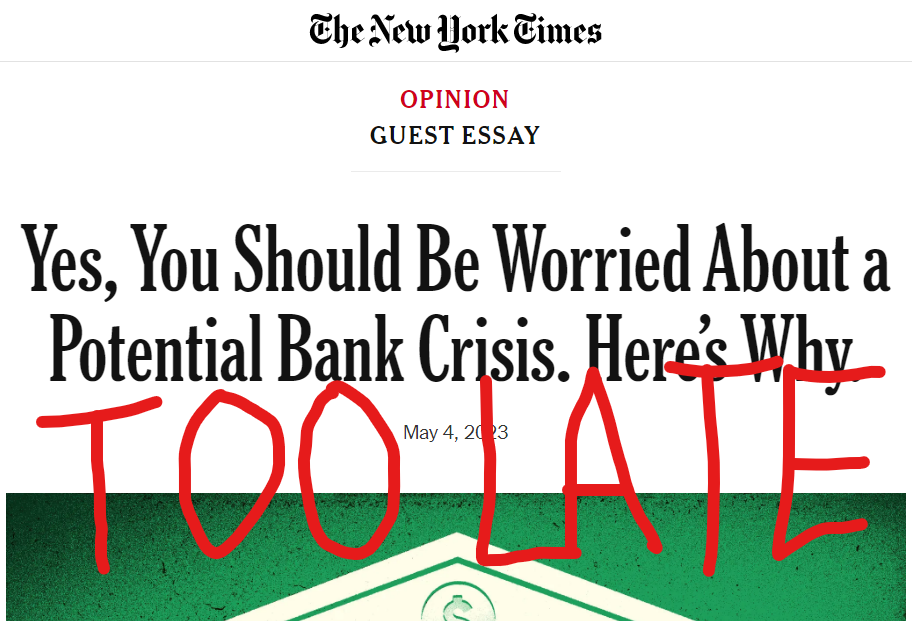
Legacy media has often acted as the mouthpiece for entrenched power, sitting squarely on the wrong side of history until the bitter end when their position becomes untenable. In fact, history is often written by the victors, and only when the battle is already lost do they reverse course and place themselves at the center of the heroic narrative.
However, the rise of social media has disrupted this narrative, and now the unraveling of stories can happen in real-time, even before they are counteracted by traditional media. In this new era, one thing has become clear: we cannot rely solely on mainstream media, financial institutions, or government, but must instead believe only in those we trust.
Despite the admission by the New York Times that we are in the midst of a bank crisis, they are missing the bigger picture. The entire system has effectively defaulted since 2008, and we have been in quiet insolvency for 15 years. This debt can never be repaid, and the only question now is how these losses will be allocated. As the banking sector consolidates, the losses are absorbed by central banks, which finance these deals through the national currency. This will lead to radical debasement and a decrease in the people’s purchasing power, which will serve as the ultimate pressure valve for this crisis. You feel it already painfully in your pockets!

Rather than acknowledging the impending doom of fiat money, traditional media is instead slandering Bitcoin. However, this narrative will not last. Bitcoin is based on a decentralized system that operates independently of rulers and has rules without rulers. In other words, it’s a system based on the believe in mathematics and freedom rather than corrupt institutions. As Bitcoin gains more accceptence and the lightning network more adoption, we will see that in the legacy media it will suddenly become as American as apple pie, and we will come to realize that it’s not just an investment but a way of life. Not only for the US but the whole world – new world patriotism.
In conclusion, it’s clear that we cannot rely solely on traditional media, financial institutions, or government to guide us through this crisis. They will not serve us solutions but are part (or the whole) problem. Instead, we must place our trust in those we believe in, such as God, mathematics, and Bitcoin. As the world continues to change, we must adapt and evolve, and only by doing so can we thrive in true freedom.
I operate my own little Lightning Node
Feel free to open a channel e.g. with
clightning
lightning-cli connect 0366217f4a7abf70842f794e94a4cbddc249d5cbaf9c0ffd0b7e4638d9bf07845d 81.7.17.202 9735
lnd
lncli connect 0366217f4a7abf70842f794e94a4cbddc249d5cbaf9c0ffd0b7e4638d9bf07845d@81.7.17.202:9735
eclair
eclair-cli connect 0366217f4a7abf70842f794e94a4cbddc249d5cbaf9c0ffd0b7e4638d9bf07845d@81.7.17.202:9735
(please be note that you have to remove hyphens from the line above, after copy/paste somewhere) or try my already working online tipping tool. Check it out! Send me some Satoshis throught the Lightning ⚡️ Network (beta, but fast as lightning!)
CBDC: Lösung der Regierung für die Rettung eines korrupten Banksystem oder sicheres Rezept für eine Katastrophe?

CDBCs sind auf dem Weg — jetzt spricht die Politik in den US es laut aus.
CBDCs kommen
und mein Eindruck, was das für unser Geld bedeutet, teile ich gerne:
In den letzten 12 Monaten sind 850 Milliarden Dollar an Einlagen von den Banken abgezogen worden. Aber das war nur der Anfang. Allein in den letzten drei Wochen wurden 130 Mrd. USD abgezogen. Wir sind Zeugen eines nationalen Bank-Runs in den USA, der in Zeitlupe abläuft. Was ist die Ursache dafür? Die Menschen wollen ihre Einlagen nicht bei einer Bank halten, die 0,01 % zahlt, wenn Geldmarktfonds über 4 % zahlen.
Mit anderen Worten: Die Regierung/Zentralbank im Auftrag der Regierung konkurriert mit ihrem eigenen Bankensystem um Gelder, und die einzige Möglichkeit, den Bank-Run zu stoppen, ist Senkung der Zinsen. Aber natürlich hat man Angst, dass eine Zinssenkung die Inflation weiter anheizen könnte – der stark geschönte Verbraucherpreisindex in den USA lag im Februar bei 6 %. Das ist eine Zwickmühle, und die Folgen sind schrecklich. Diese Politik hat bereits das schlimmste Gemetzel an Bankzusammenbrüchen seit 2008 verursacht.
Die Credit Suisse – ein 167 Jahre altes Institut – ist über Nacht verschwunden. Vermutlich wäre die Fed von all dem etwas überfordert gewesen. Aber nein, inmitten dieses Blutbads fand sie irgendwie die Zeit, die Einführung eines aufregenden neuen Dienstes namens FedNow im Juli anzukündigen. FedNow ist eine digitale Zahlungsinfrastruktur, die von der Fed kontrolliert wird.
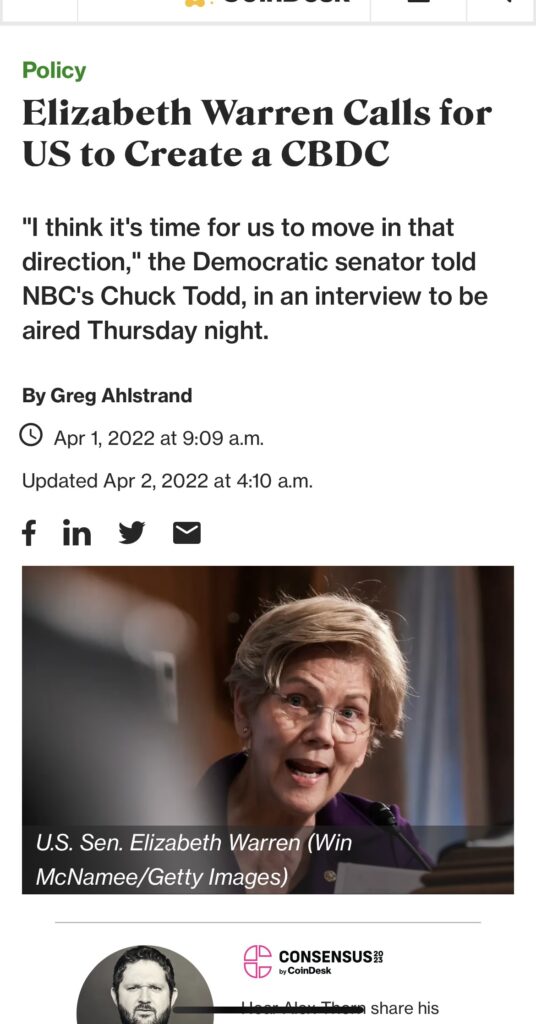
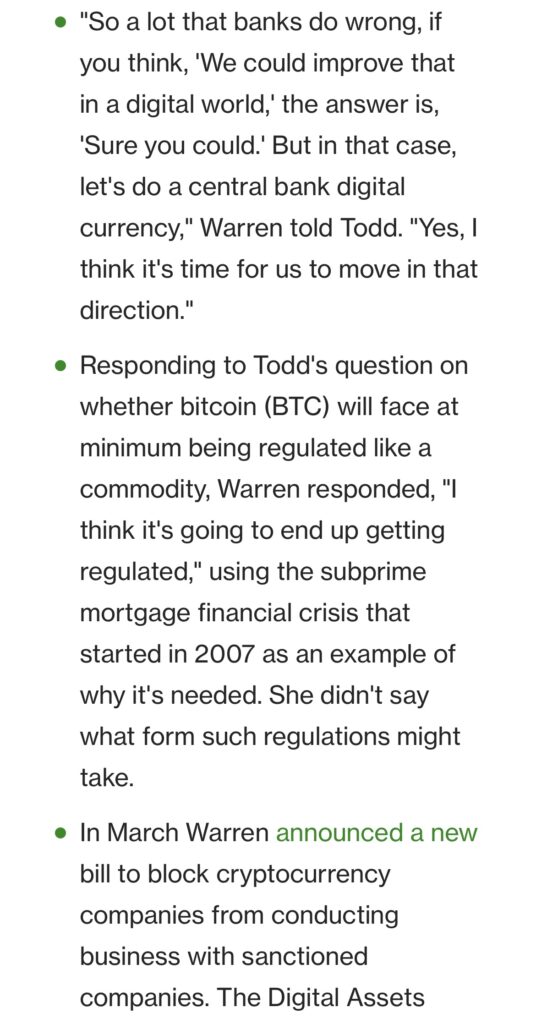
Wie aufs Stichwort treiben nun niederträchtige Opportunisten wie Elizabeth Warren die CBDC-Agenda offen voran und bilden Anti-Krypto-Koalitionen. Es bleibt nur die flackernde Erinnerung an Warrens scheinbar rechtschaffenen Kreuzzug gegen die Banken im Anschluss an 2008. Doch inzwischen ist auf widerliche Weise klar geworden, dass es ihr nie um die Befähigung des Einzelnen ging, sondern um mehr staatliche Kontrolle.
Und Senatorin-Karen ist nicht allein
EZB-Präsidentin Christine Lagarde bemüht sich, den digitalen Euro bis Oktober voranzubringen, und hat gerade angekündigt, eine Obergrenze von 1.000 Euro für Bargeld- und Kryptozahlungen einzuführen:
„Wenn wir uns nicht am digitalen Zentralbankgeld beteiligen […], riskieren wir, die Rolle des Ankers zu verlieren, die wir seit vielen Jahrzehnten gespielt haben.“ Die Menschen sollen also ihr Geld digital halten, aber nicht mehr als 1.000 Euro online nutzen können. Die Angst der Politik ist geradezu greifbar.
Das liegt daran, dass es bei diesem neuen Gefühl der Dringlichkeit nicht nur um Bankenzusammenbrüche geht. Es wird wohl auch damit zu tun haben, dass die Finanzweltordnung auf den Kopf gestellt wird und jahrzehntelange Übereinkommen in Frage gestellt sind. Brasilien, Russland, Indien, China und Südafrika haben angekündigt, nicht mehr in Dollar, sondern in ihren Landeswährungen abzurechnen.
Gleichzeitig hat die OPEC gerade ihre Muskeln spielen lassen, indem sie ihre Ölproduktion freiwillig um mehr als 1 Million Barrel pro Tag gesenkt und damit die Inflation im Westen angeheizt hat. Dies veranlasste Japan, sich von den US-Verbündeten abzusetzen und unter Berufung auf seinen Energiebedarf russisches Öl zu kaufen, das über der Obergrenze von 60 Dollar liegt, die für die G7-Länder gilt. Der Machtverlust im Ausland veranlasst die westliche Führung dazu, die eigene Bevölkerung hart zu kontrollieren, um überhaupt ein gewisses Maß an Kontrolle über Fiskalpolitik zu behalten.
Denjenigen, die nicht bereit sind, sich in die Todeszellen der CBDCs und strenge Kapitalkontrollen treiben zu lassen, könnte die Zeit davonlaufen. Ich möchte nicht falsch verstanden werden: Grundsätzlich war es längst an der Zeit Währung und Zahlungen zu digitalisieren. Bitcoin ist diesen Weg gegangen und hat gezeigt, wie man wahre finanzielle Unabhängigkeit, Sicherheit und Freiheit erreichen kann. Doch die letzten 10-12 Jahre legten die Versäumnisse der Regierungen, die Marode des globalen Finanzsystem und den Unwillen der Zentralbanken offen, Macht zurück an die Menschen zu geben.
Es ist Zeit aufzuwachen und sich zumindest persönlich in Teilen von der Finanzpolitik der Zentralbanken, staatlichen und privaten Banken und der Regierung zu emanzipieren!
#Bitcoin now!
Wahnsinn ist wie Schwerkraft

Eine 2 Billionen Dollar Rettungsaktion für das Bankwesen! Die können nicht aufhören, Geld zu drucken. Das ist der grundsätzliche Schluss, die man hier ziehen muss.
Inflation sollte nicht real sein.
Aber die Preise steigen und jeder (!) auf der Welt merkt das in den letzten Jahren und Monaten deutlich.
Die Wirtschaft sollte stark sein.
Aber allein in diesem noch jungen Jahr 2023 wurden bereits 100.000 Beschäftigte in der Technologiebranche entlassen.
Der Finanzsektor sollte stabil sein.
Aber 2 der 3 größten Bankenzusammenbrüche der Geschichte fanden letzte Woche statt.
Die Rettungsaktion für die SVB sollte 25 Milliarden Dollar betragen.
Aber vier Tage später werden daraus 2 Billionen Dollar für den gesamten Finanzsektor.
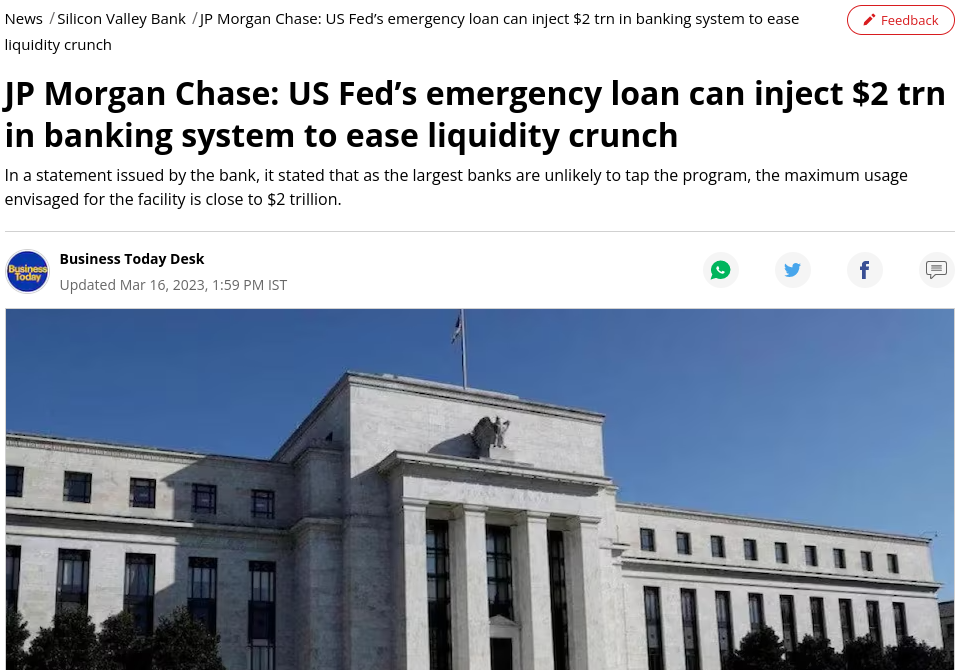
Fällt hier noch jemandem ein Muster auf?
Die Regierungen und Zentralbanken können nicht aufhören Geld zu drucken.
Wenn JP Morgan Recht hat, werden die 2 Billionen Dollar, die über das neue Kreditprogramm BTFP bereitgestellt werden, die Fed-Bilanz um 20 % erhöhen.
Das bedeutet 6’000 Dollar für jeden amerikanischen Mann, jede Frau und jedes Kind – neue Schulden.
Zufälligerweise wird jeder einzelne Schweizer Bürger in ähnlicher Weise 6’000 Dollar für die Rettungsaktion der Credit Suisse bezahlen – neue Schulden.
Das sind 54 Milliarden Dollar, die für eine einzige Bank mit einem Marktwert von 8 Milliarden Dollar versch(w)endet werden. Das ist ein Geschäft, das nur eine Regierung willig ist, einzugehen.
Muss uns das als Europäer denn interessieren? Es geht ja um amerikanische Banken und vielleicht um eine Schweizer Bank. Und überhaupt die Europäische Zentralbank …
Es ist ein Irrglaube, anzunehmen, das es in Europa „schon nicht so schlimm kommen wird“, dass es die Zentralbanken und Regierungen schon machen werden und, dass die Zinspolitik in Europa eine andere ist, usw …
Fakt: Gerade eben erst wurde in einer EZB-Ratssitzung eine Zinserhöhung auf 3,5 Prozent beschlossen.
Aber halt, es kommt noch besser.
Da es offenkunding wird, dass das gesamte Finanzsystem vollkommen auf der Unterstützung der Zentralbank wie auf riesigen Stelzen dahirstakst, werden viele Menschen unweigerlich falsche Schlüsse aus der „Rettung“ ziehen.
Wir sehen nämlich nicht, dass das faule politische Gelder (also die inflationäre Geldpolitik an sich) die Ursache für die zunehmenden Misserfolg von Banken ist. Wir nehmen an, die müssten gerettet werden, um die Gelder der einfachen Menschen zu schützen. Doch wird damit der Bock zum Gärtner gemacht und die Menschen glauben an die die warme Umarmung der Zentralbank und hoffen gar darauf. Dabei rettet das marode System sich nur kurzfristig selbst – zu Lasten der Steuerzahler … und der Nicht-Steuerzahler … und der Kinder … und Arbeitslosen … und Rentner … und Arme …
Am Ende profitieren nur die Banken von einem direkten finanziellen Engagement, einer „Vertragspartei“ oder einem Partner, der praktisch ausfallsicher ist, weil er sich im Zweifel immer neues Geld drucken kann und davon auch fleißig Gebrauch macht. Die Last trägt aber dann jeder durch die Inflation und steigenden Preise. Man sieht die direkte Verbindung nur nicht.
Warum aber sollten die Regierungen Interesse daran haben, gute und hart arbeitende Menschen davon auszuschließen, durch die Rettung des Finanzsystems zu profitieren?
Im Grunde wird der Normalbürger in finanzielle Abhängigkeit gebracht und ausschließlich als Konsument betrachtet. Konsument von Zahlungsdienstleistungen und zur Verfügung gestelltem Finanzmitteln gegen Bereitstellung von Arbeitskraft. Hier kommen sie ins Spiel, die „vertrauenswürdigen“ CBDCs, also durch die Zentralbanken ausgegebene und verwaltete Digitale Währungen. Und die sind nicht nur schon voll in Arbeit, es werden auch schon jetzt die unterliegenden Strukturen zementiert, die CBDCs für den Bürger zwingend erscheinen lassen.
Wenn man darüber nachdenkt, sind Schatzämter der Regierungen schon heute eine Art von CBDC für Banken. Es ist aber so, dass nur Institutionen Zugang zu den Konten der Zentralbanken haben.
Aber was gut für die Gans ist, ist auch gut für den Gänserich
Es ist bestimmt kein Zufall, dass die Fed erst vor kurzem angekündigt hat, dass ihr aufregender neuer FedNow Service im Juli seinen Betrieb aufnehmen wird. Toll, oder? Man müsste jetzt noch wissen, was das ist.
Der FedNow Service wird es Finanzinstituten – unabhängig von ihrer Größe oder geografischen Lage – ermöglichen, rund um die Uhr und an jedem Tag des Jahres landesweit Sofortzahlungsdienste anzubieten. Also Banken können global zu jeder Zeit Sofortzahlungen anbieten. Das hört sich erstmal super an, wie ein Kind von VISA und Paypal auf Steroiden. Aber die wahren Eltern sind Regierungen und Zentralbanken und genau die werden die Kontrolle über die Geldmenge in eine Virtuelle Umgebung verlagern – außerhalb der Reichweite der Normalbürger und eingebettet in ein marodes Finanzsystem. Ein „Schuldscheinsystem“ außerhalb der Kontrolle des Nutzers.
Wird die nächste Krise FedNow für die breite Öffentlichkeit erzwingen?
„Wahnsinn ist wie Schwerkraft: Man braucht nichts weiter als einen kleinen Schubs.“
Heath Ledger in „The Dark Knight“ (2008)
An idealist’s and a maximalist’s hope
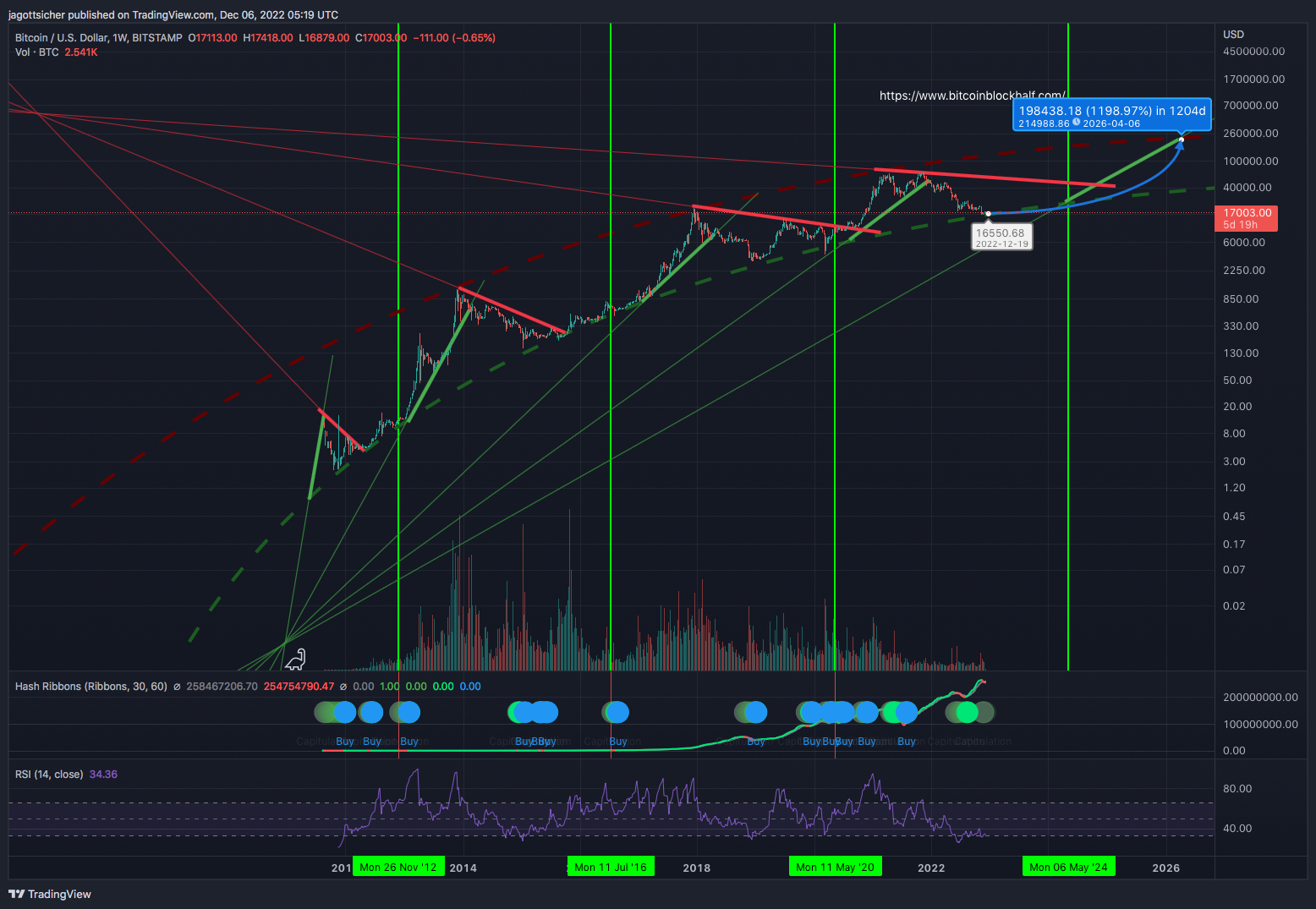
I am not a trader but an idealist and a maximalist.
New horizon for end of crypto winter and the start of the next (5th) bull circle.
Goal: Sell at 200k, depending on #inflation for #fiat maybe better to stay in #Bitcoin!
Feel free to checkout my … https://bit.ly/3iyM7L3
#wp
I am not a trader but an idealist and a maximalist.New horizon for end of crypto winter and the start of the next (5th) bull circle.
Goal: Sell at 200k, depending on #inflation for #fiat maybe better to stay in #Bitcoin!
Feel free to checkout my … https://bit.ly/3iyM7L3
— Jens Schendel⚡️ (@jagottsicher)
Dec 6, 2022